
9 Kings Best Builds: 7 Compositions That Win Runs
Seven proven 9 Kings builds for the 1.0 launch, with the exact engine, payoff cards, decree picks, and the mistake that breaks each composition.
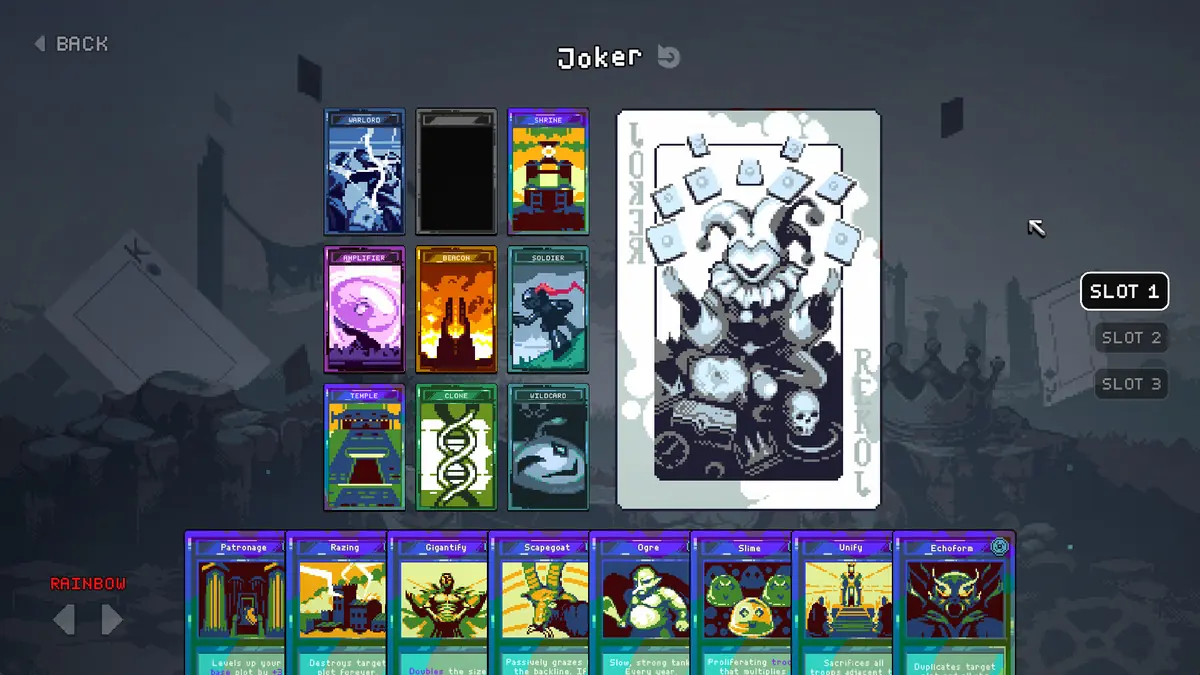
Quick answer: The seven strongest 9 Kings builds are Knight Haven, Static Spire, Vault Dispenser, Demon's Altar, Boar Grove, Warlord Migration, and Lab Rat Progress. Each one has a clear engine, a payoff card, and a reason it can beat the year-33 boss.
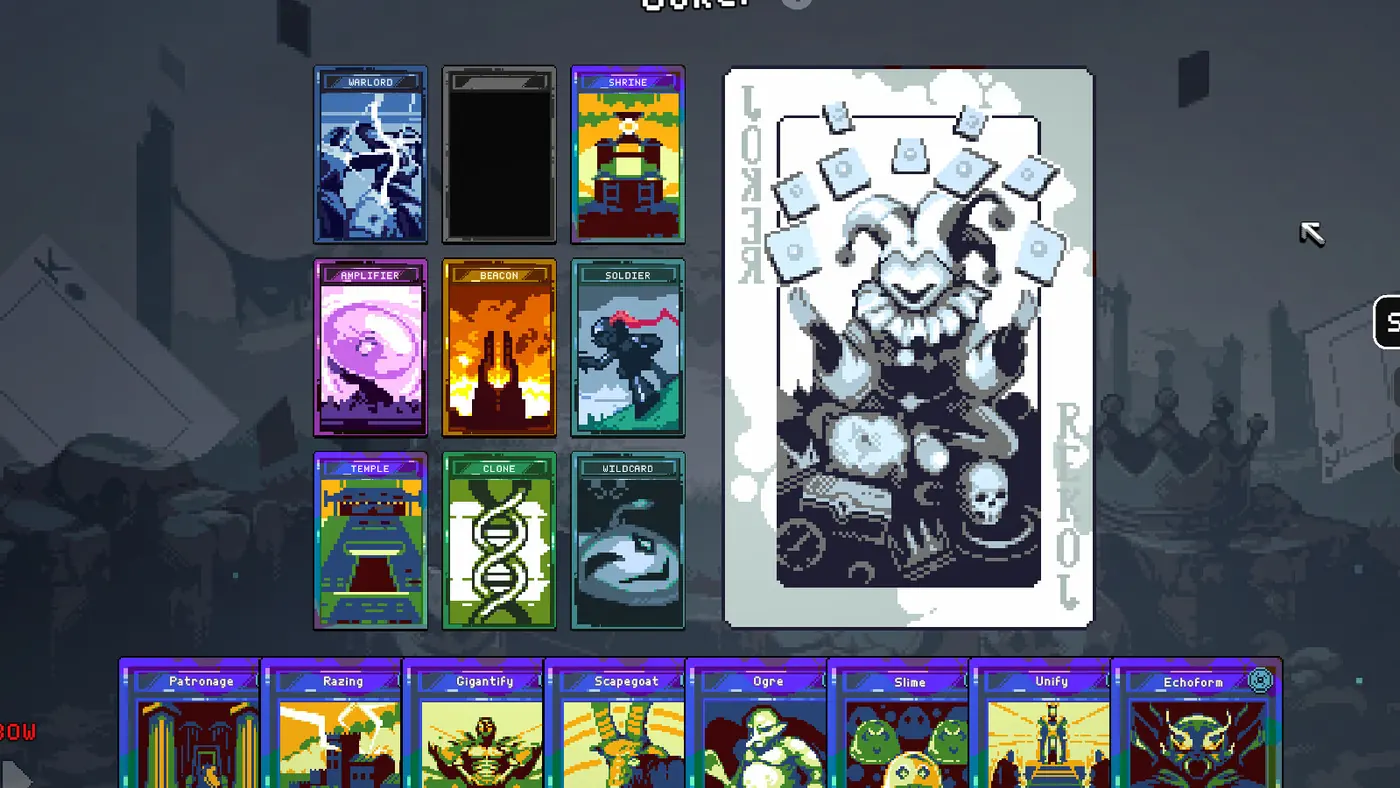
A 9 Kings build is not a list of nine cards. It is an engine plus a payoff. The engine generates a resource every year, and the payoff converts that resource into damage or survival. If you copy the payoff without the engine, the build does not work.
The seven builds below are ordered by how reliably they convert a normal run. None of them requires a perfect draft. Each entry names the engine, the payoff, the decree you want, and the failure mode to avoid.
1. Knight Haven (King of Nothing)
Engine: Farm and Blacksmith, both adjacent to one Knight or Paladin. Payoff: Steel Coat stacked on the same unit.
The King of Nothing has the cleanest beginner build in the game. A Farm adds +1 unit per year to an adjacent troop, and a Blacksmith adds +2% attack per year. Put both next to a single Paladin and the unit scales in two directions at once. Steel Coat cancels the first hit each battle, and multiple copies stack with no limit.
The reason this build works is that Nothing's troops already have strong base stats. You are not fixing a weak unit; you are multiplying a good one. Add a Scout Tower behind the cluster for chip damage and a second Farm only if it touches the same unit.
Decree: Sharp Blades or Feast. Sharp Blades is the safer pick because it also helps your towers. Failure mode: putting the Farms next to three different troops. The build needs one unit, not a crowd.
2. Static Spire (King of Spells)
Engine: Wizard or Shaman with high attack speed. Payoff: Static, plus Spire healing.
Static makes attacks trigger a lightning chain, and each stack adds damage and one more chain. That means attack speed is not a minor stat for this build; it is the whole engine. Put Static on a Wizard, then support it with attack-speed buffs and a Spire that heals the lowest-health ally.
The build is fragile early because the King of Spells has few bodies. You need a front line from another king, usually Soldiers or Paladins, before the chain comes online. Library is the glue: it copies an enchantment from an adjacent troop every year, which turns one Static into two.
Decree: Static Fields if it is offered, otherwise Sharp Blades. Failure mode: casting Static on a slow unit. The chain needs volume, not one big hit.
3. Vault Dispenser (King of Greed)
Engine: Vault and Beacon. Payoff: Dispenser.
Vault adds +3 gold per year at each level. Beacon gives adjacent plots +2% attack speed per year. Dispenser gains +1% attack speed for every gold you earn. Put the three together and the gold engine becomes a damage engine.
This is the most economic build in the game. It struggles in the first ten years because the pieces do not do much on their own. Once Vault is level 2 and Dispenser has a few years of income behind it, the attack speed snowball becomes difficult to stop.
Decree: Loan or Sharp Blades. Loan accelerates the engine; Sharp Blades raises the ceiling. Failure mode: buying the payoff before the engine. A Dispenser with no Vault is a slow tower.
4. Demon's Altar (King of Blood)
Engine: Pagoda and Cemetery, plus cheap units that die. Payoff: Demon's Altar and Mangler.
Blood turns deaths into stats. Pagoda summons imps, Cemetery summons an imp when an adjacent unit dies, and Demon's Altar summons a demon at each level while gaining permanent damage for every ally that dies. Mangler sacrifices an adjacent unit each year for +2 damage.
The build wants a wide board of disposable units around a small number of scaling threats. It is the opposite of Knight Haven: you do not protect one unit, you feed the machine. Vampirism keeps the key units alive long enough to benefit.
Decree: War Horns or Feast. War Horns increases summon count; Feast doubles max HP so the sacrifices survive longer. Failure mode: sacrificing your only damage dealer. Feed the Altar, not the unit that wins the battle.
5. Boar Grove (King of Nature)
Engine: Forest and Mycelium. Payoff: Boar and Treant.
Nature scales through health. Forest gives adjacent plots +2% HP per year, Mycelium spawns spores every nine seconds, and Treant heals allies while damaging enemies. Boar is the payoff: it can be ridden, and every point of HP gives the rider +1% stats.
The build is slow but extremely hard to kill once it is online. Procreate adds nine units, which gives the Boar more HP to convert. Orchard roots enemies in place so the Boar can connect.
Decree: Fertility or Feast. Fertility adds Procreate cards; Feast doubles HP. Failure mode: building damage items on a health-scaling unit. The Boar wants HP, not crit.
6. Warlord Migration (King of Nomads)
Engine: Camp and Migration. Payoff: Warlord.
Nomads is a movement build. Warlord is a base and a troop at the same time, and its banner buffs nearby units. Camp gives adjacent plots +2% when you place a card on an empty plot. Migration moves a unit to an adjacent empty plot and gives it +10% attack and HP.
The play pattern is to keep moving the Warlord and its supports, re-triggering Camp and stacking Migration. Swords and Shields add flat or percentage stats, whichever is higher, which makes them strong at every stage.
Decree: Leatherworks or Sharp Blades. Leatherworks doubles move speed and makes the repositioning plan faster. Failure mode: letting the Warlord stand still. A static Nomads kingdom is a worse Nothing kingdom.
7. Lab Rat Progress (King of Progress)
Engine: Reinforce and Concabulator. Payoff: Lab Rat and Defender.
Progress turns upgrades into stats. Reinforce gives a unit +1% damage whenever any plot is upgraded. Concabulator upgrades every plot by one level when it reaches level 3. Lab Rat gains a level whenever an adjacent plot is upgraded, with no cap.
The build has the highest ceiling in the game and the most awkward opening. You need to upgrade plots constantly, which costs gold, and you need the Lab Rat next to the upgrades. Defender is the safety net: it does not attack, but it reflects all damage, which buys time for the rats to grow.
Decree: Sharp Blades or Exploration. Exploration gives more plots to upgrade. Failure mode: upgrading random plots instead of the ones adjacent to the Lab Rat.
Honorable mentions
Ballista Fortress (Stone) is a legitimate tower build: Stronghold summons towers, Trebuchet adds a rock per building, and Ballista pierces. It is slower than the seven above but very safe.
Portal Amplifier (Time) has a high ceiling but a complicated setup. Portal returns you to a past year while keeping kingdom progress, and Amplifier copies every buff it receives to adjacent plots. It is worth learning after you have a few wins.
How to choose
If you are new, play Knight Haven. If you want the strongest late game, play Lab Rat Progress. If you want the safest run, play Ballista Fortress. If you want to understand the draft, play Vault Dispenser, because it teaches you how gold converts into damage.
Do not switch builds at year 20. The whole point of a build is that the pieces reinforce each other. A half-finished Knight Haven plus a half-finished Static Spire is worse than either one alone.
The tier list→ ranks the kings themselves, and the best cards→ page explains which individual cards are worth building around.
Every failed build in this list fails for the same reason: the payoff card arrived before the engine. Buy the Farm before the Paladin, the Vault before the Dispenser, the Pagoda before the Altar.
FAQ
What is the best build in 9 Kings? Lab Rat Progress has the highest ceiling, but Knight Haven is the most reliable for a new player.
Can I mix two builds? Only when they share support. A tower build with one enchanted unit is fine; two unrelated engines are not.
Do builds need specific decrees? They perform better with the listed decree, but none of them collapses without it. The engine matters more.
Which build is best for the Final Battle? Any build with a single high-health damage dealer and a protected tower line. Knight Haven and Lab Rat Progress are the most consistent.
Sources
Official source: 9 Kings Steam store page ↗