
King of Nothing Build Guide: Knight Haven Explained
A complete King of Nothing build for 9 Kings 1.0: the Knight Haven carry, exact card priorities, decree and perk picks, and the mistakes that break the stack.
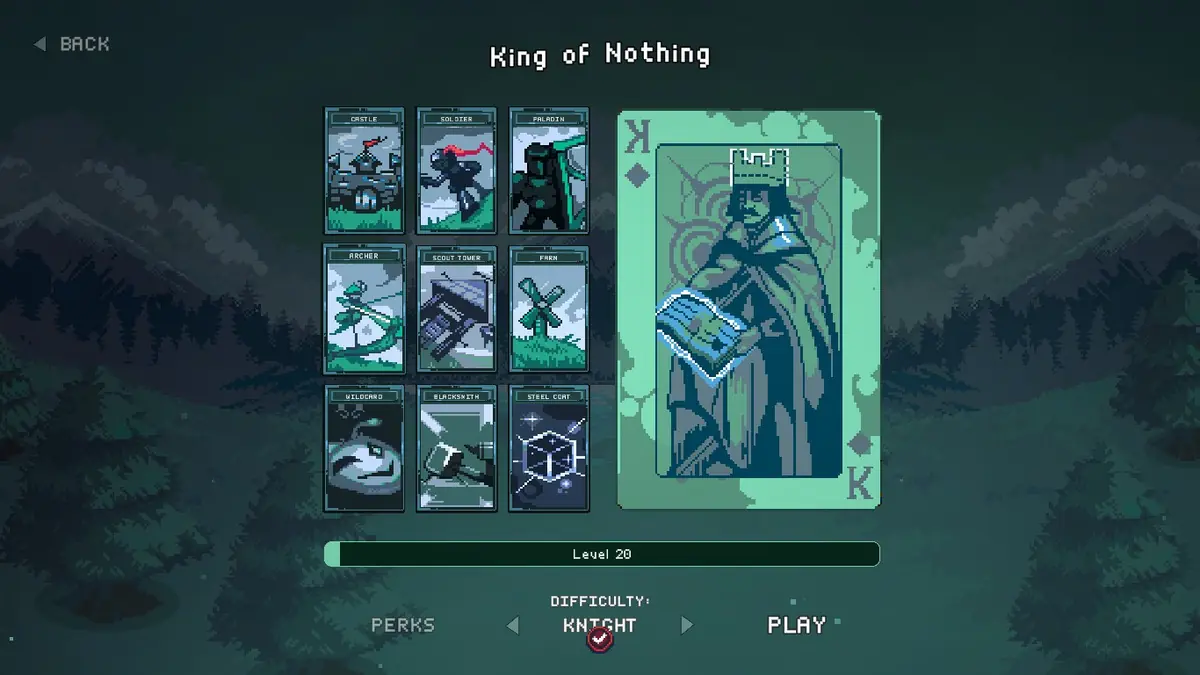
Quick answer: The King of Nothing build is Knight Haven: one Paladin, two Farms, a Blacksmith, stacked Steel Coats, and a wall of cheap bodies. It is the most reliable beginner build in 9 Kings because every piece is common and the plan does not depend on a rare card.
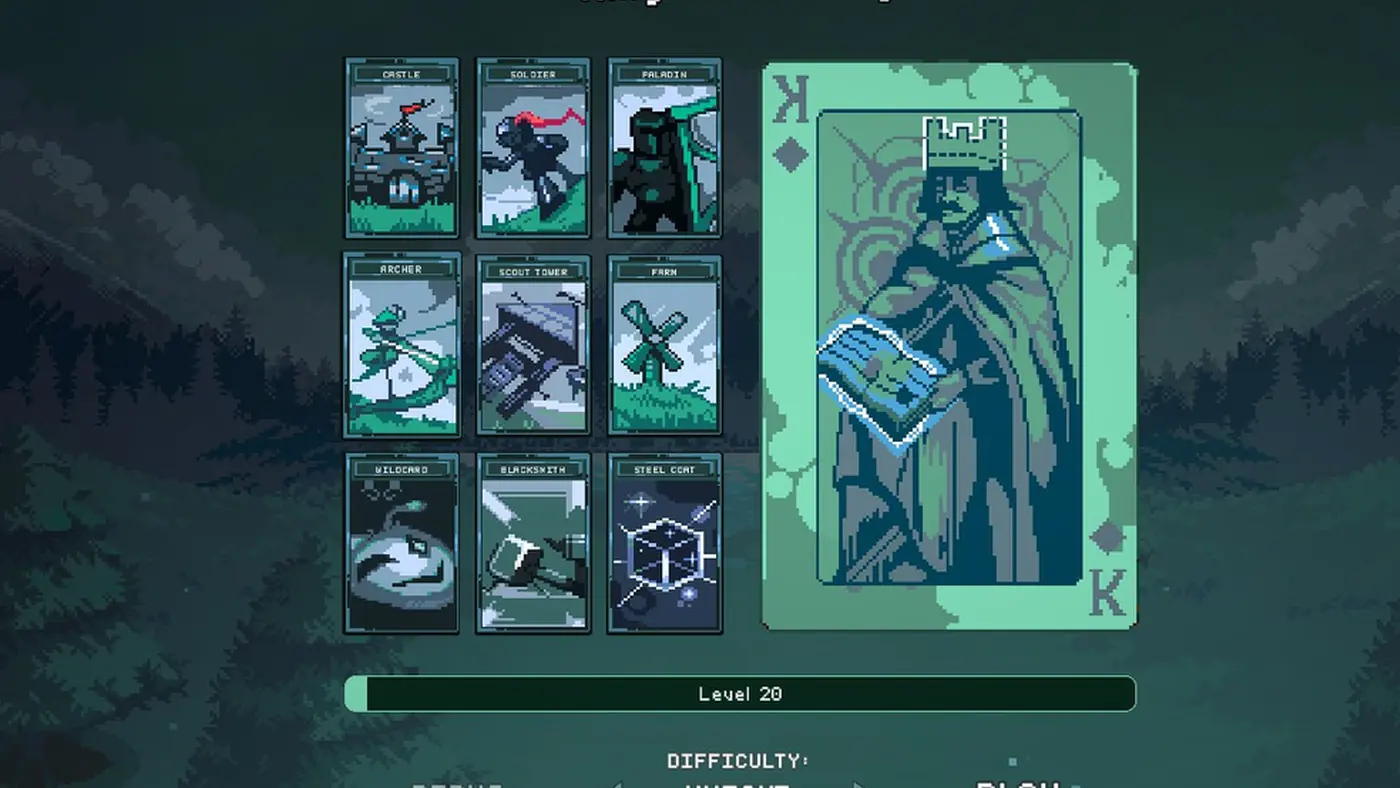
Nothing is the first king most players see, and it is easy to dismiss as the tutorial deck. That would be a mistake. Nothing has the cleanest support package in the game: Farm adds units, Blacksmith adds attack, Steel Coat adds survivability, and Paladin converts all three into a carry.
The result is a build that is strong at every skill level. Beginners can pilot it with a simple rule; experts can squeeze extra value out of adjacency, decree timing, and perk layout.
The deck
Nothing's nine cards:
- Castle (base): area projectile.
- Soldier (troop): cheap body.
- Archer (troop): ranged damage.
- Paladin (troop): the carry.
- Scout Tower (tower): cheap ranged support.
- Farm (building): +1 unit per year to adjacent troops.
- Blacksmith (building): +2% attack per year to adjacent troops.
- Wildcard (tome): levels up a plot.
- Steel Coat (enchantment): cancels the first hit each battle.
The deck has one obvious carry, two support buildings, one defensive enchantment, and enough filler to function when the draw is bad. That is why it is consistent.
The core engine
Knight Haven is a three-card engine:
- Paladin on the carry plot.
- Farm adjacent to the Paladin.
- Steel Coat on the Paladin.
Farm gives the Paladin +1 unit every year. Steel Coat gives it one free hit every battle. Together they turn a good troop into a unit that survives long enough for its damage to matter.
The fourth piece is Blacksmith. +2% attack per year is slow, but it compounds. By year 20, a Blacksmith has added 40% attack to the Paladin, which is more than most decrees.
Opening priorities
Years 1–3: take Paladin if it appears. If it does not, take Farm or Blacksmith and wait. Do not take Archer or Soldier as a carry; they do not scale.
Year 4: take Sharp Blades or Feast. Sharp Blades is better if your Paladin is already alive; Feast is better if you are losing battles.
Years 5–7: place Farm next to the Paladin. Place Steel Coat on the Paladin. If you have a second Steel Coat, stack it.
Years 8–11: save gold for the merchant. Do not reroll.
Year 12: buy a second Farm or a Blacksmith. If the merchant has Steel Coat, buy it.
The full board
By year 20, the board should look like this:
- Base plot: Castle.
- Carry plot: Paladin, adjacent to the base.
- Support plots: Farm and Blacksmith on the other sides of the Paladin.
- Front line: Soldier or Archer as a screen.
- Kill zone: Scout Tower behind the Paladin.
- Open plot: one slot for a reactive card.
Do not put the Paladin on the front line. It needs to be close enough to defend the base but far enough back that the enemy hits your screen first.
Decrees
The best decrees for Knight Haven:
- Sharp Blades: +30% attack for 20 years. The default.
- Feast: double max HP for 20 years. Take it against a hard boss.
- Overwork: support buildings trigger one more time. Excellent with Farm and Blacksmith.
- Exploration: three extra plots. Good if your board is cramped.
Avoid Bunker. Towers are a support piece in this build, not the damage.
Perks
The Nothing perks that matter:
- Protector: +1 Steel Coat at the start. The best perk for this build.
- Agricultural: +1 Farm. A free support building.
- Valiant: +3 Paladin units. A direct buff to the carry.
- Farsighted: +20% Archer range. Useful if you use Archers as the screen.
- Recruiter: Soldier +10% all stats. A good fallback if you cannot find Paladin.
Universal perks: Ingenious, Expansionist, Persistent, Nurturer, and Castellan are all good. Nurturer is especially strong because the Paladin wants HP.
The Final Battle
Knight Haven beats the year-33 boss by outlasting it. The Paladin should have at least two Steel Coats, a Farm, and a Blacksmith by year 32. Save one defensive card in hand for the boss.
If the boss reaches the Castle, you lose. Keep the screen alive and the Paladin between the boss and the base.
Common mistakes
Putting Farm next to three troops. Farm is strongest when it feeds one carry. Three troops get +1 unit each, which is fine, but the Paladin gets +1 unit per year instead of +3.
Skipping Steel Coat. A Paladin without defensive support dies to burst. Steel Coat is not optional.
Building a second carry. Two Paladins split your Farms and Blacksmiths. One is better.
Taking Bunker. Towers are not your damage. Sharp Blades or Feast is better.
Ignoring the screen. The Paladin cannot tank everything. A cheap Soldier in front buys the time your support needs.
The best builds→ page compares Knight Haven with the other compositions, and the kingdom layout→ page shows the exact plot shape.
Multiple Steel Coats stack with no limit. Three copies on a Paladin is not overkill; it is the plan.
FAQ
Is King of Nothing good in 9 Kings? Yes. It is not the strongest king at the highest level, but it is the most consistent and the best learning deck.
What is the best King of Nothing build? Knight Haven: Paladin, two Farms, Blacksmith, stacked Steel Coats.
Should I use Archer or Soldier? Soldier is the better screen; Archer is the better ranged support. Use both if you have plots.
Can Knight Haven beat the Final Battle? Yes, with two or more Steel Coats and a protected base.
Sources
Official source: 9 Kings Steam store page ↗