
King of Nature Build Guide: Boar Grove Scaling
A King of Nature build for 9 Kings 1.0: Boar plus Forest and Treant, the HP-to-damage conversion, and the slow game plan that beats the year-33 boss.
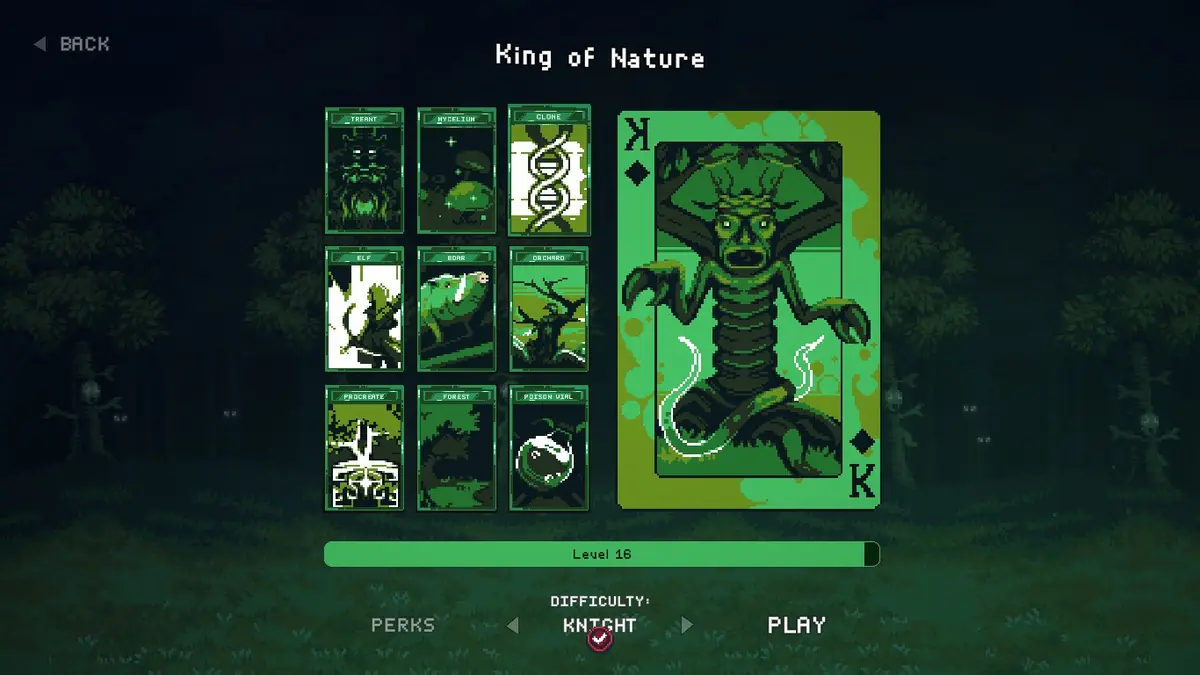
Quick answer: The King of Nature build turns HP into damage. Boar gains +1% stats per point of HP, Forest and Treant add HP, and Orchard roots keep enemies in range. It is the slowest build in 9 Kings and one of the most reliable late.
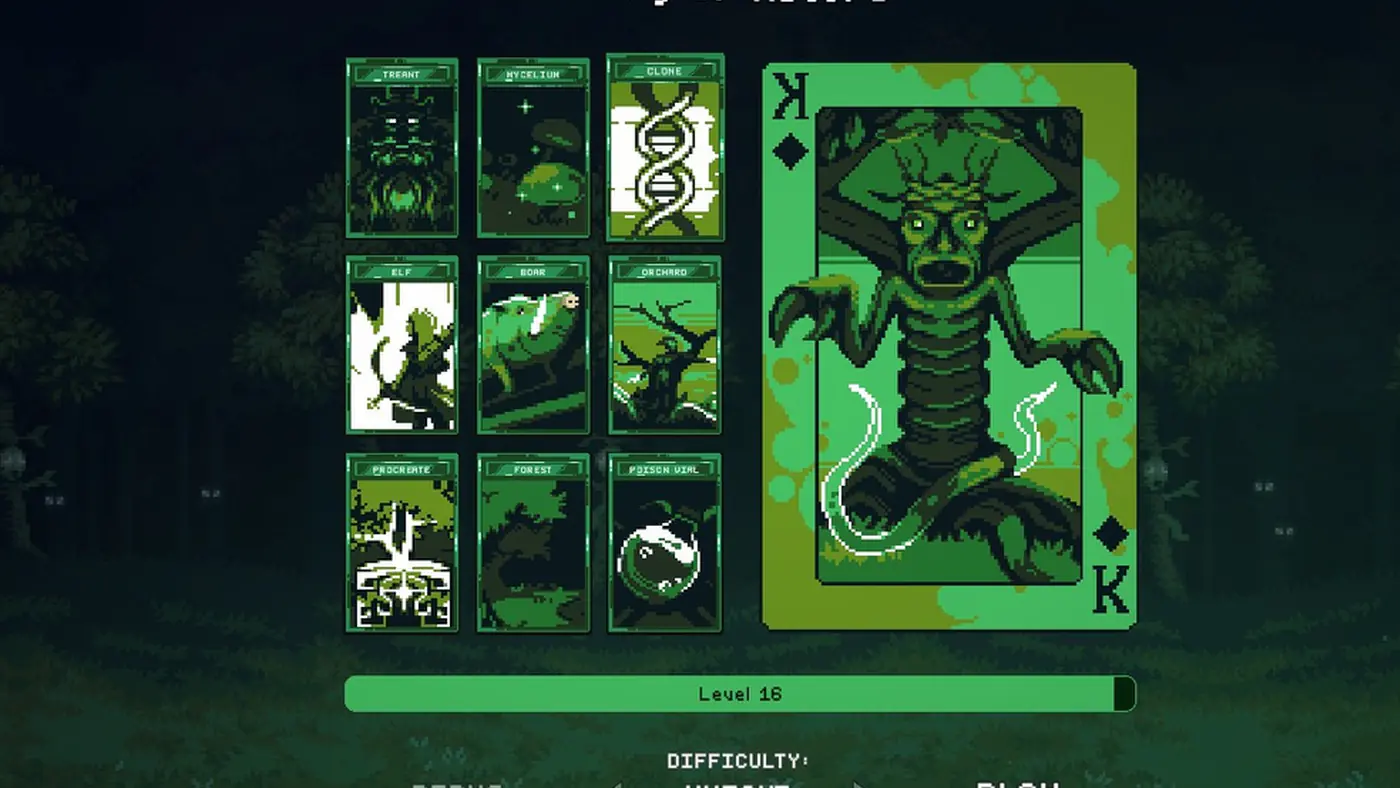
Nature is the patient king. Its cards do not have the burst of Blood or the economy of Greed. What they have is sustain: healing, HP buffs, roots, and a carry that converts all of it into damage.
The result is a build that feels weak for 15 years and then refuses to die.
The deck
Nature's nine cards:
- Treant (base): heals allies and damages enemies.
- Elf (troop): snipes the farthest enemy.
- Boar (troop): can be ridden; each HP gives the rider +1% stats.
- Mycelium (building): summons spores every nine seconds; stacks across battles.
- Clone (tome): copies a plot card.
- Orchard (building): roots enemies; three roots per level.
- Procreate (tome): adds nine units to a troop.
- Forest (building): +2% HP per year to adjacent troops.
- Poison Vial (enchantment): adds poison damage.
The deck has one carry, two HP engines, one healer, and enough control to survive.
The Boar Grove engine
The core loop:
- Boar on the carry plot.
- Forest adjacent to the Boar.
- Treant healing the Boar.
- Orchard rooting enemies in range.
Boar converts HP into stats, so Forest is not just defense; it is offense. Treant keeps the Boar alive, which keeps the conversion going. Orchard prevents enemies from walking past the Boar.
The result is a carry that gets stronger every year and is very hard to kill.
Opening priorities
Years 1–3: take Boar if it appears. If not, take Forest or Treant. Do not take Elf as a carry; it does not scale with HP.
Year 4: take Feast or Sharp Blades. Feast is better because it doubles the stat the Boar converts.
Years 5–7: place Forest next to the Boar. Place Treant behind the Boar. If you have Orchard, place it in front.
Years 8–11: save gold. Nature wants a second Forest or a Procreate at year 12.
Year 12: buy Forest, Procreate, or Orchard. Do not buy a second carry.
The full board
By year 20:
- Base plot: Treant.
- Carry plot: Boar with Forest adjacent.
- Support plots: Forest, Orchard, Mycelium.
- Front line: Orchard roots and a cheap body.
- Kill zone: Treant's damage plus the Boar.
- Open plot: a second Forest or a defensive card.
Keep the Boar behind the Orchard. The roots buy time for the HP conversion to matter.
Decrees
The best decrees for Nature:
- Feast: double max HP. The best Nature decree.
- Sharp Blades: +30% attack. The Boar still needs damage.
- Exploration: extra plots. Nature needs room for Forest and Orchard.
- Overwork: support buildings trigger one more time. Excellent with Forest.
Avoid Bunker. Towers are not the plan.
Perks
The Nature perks that matter:
- Elven: +10% Elf damage. Good if you use Elf as a secondary.
- Gardener: +1 Orchard root. More control.
- Toxic: +10% poison damage. Good with Poison Vial.
- Healer: +10% Treant healing. More sustain.
- Tenacious: +10% HP for all troops. Direct Boar scaling.
Universal: Ingenious, Expansionist, Persistent, Nurturer, and Holy. Nurturer and Holy both feed the Boar.
Enchantment priorities
Boar is the only unit that should receive a permanent enchantment in most Nature runs. Poison Vial is the default because it adds damage without competing for HP, and the Boar attacks often enough to keep the stacks rolling.
If you are facing a swarm, put the first Poison Vial on the Treant instead. Treant's damage hits multiple targets, and the poison spreads faster than the Boar's single-target attacks. Move the vial later only if you can afford to lose the tempo.
Do not enchant the Elf unless the Elf is your second carry. Elf damage does not feed the Boar's HP conversion, and a split enchantment budget is the most common reason Nature boards stall at year 20.
Forest and Feast are multiplicative with each other: Forest raises max HP per year, Feast doubles the total. Take Feast before a hard fight, not after, because the doubled maximum does not heal the Boar. Treant's heal is what converts the new maximum into actual HP.
The Final Battle
Nature is one of the best Final Battle builds because the Boar can outscale the boss. By year 33, Forest and Feast should have doubled or tripled its HP, which means its damage has doubled or tripled too.
The weakness is speed. The Boar is slow, and the boss may reach your base before the Boar kills it. Orchard roots and a wall are mandatory.
Common mistakes
Building a second carry. The Boar needs all the HP support. A second carry splits it.
Skipping Orchard. Without roots, the Boar cannot catch ranged enemies.
Taking Feast too late. Feast doubles max HP, but it does not heal. Take it before a hard fight, not after.
Ignoring the early game. Nature is weak before year 15. Take safe fights and protect your lives.
The best units→ page explains the Boar's HP conversion, and the kingdom layout→ page shows where to put the grove.
Feast doubles max HP but not current HP. Heal your Boar after taking it.
FAQ
Is King of Nature good in 9 Kings? Yes. It is a top-tier late-game king with a slow, reliable game plan.
What is the best Nature build? Boar Grove: Boar, Forest, Treant, Orchard.
Should I use Elf or Boar? Boar is the carry. Elf is a secondary ranged unit.
How do I unlock King of Nature? Train 999 units across your runs.
Sources
Official source: 9 Kings Steam store page ↗